Showing posts with label Computational Geometry. Show all posts

Saturday, August 20, 2011

Maximum Triangle Area (Part 3 and final)

Part 1
Part 2

After second part, our algorithm became something like this -
for each 0 <= i < n, initialize A = Pi, B = P(i + 1) % n, C = P(i + 2) % n, then move C counter clockwise until area non-decreasing, move B to its adjacent point counter clockwise, if area non-decreasing, move C again until area non decreasing and so on. You will get the maximum area for each A and output the maximum of these areas. For a given point starting point Pi, if the maximum area is ABC. We can say ABC is 'stable' triangle for A, in other word s(pi, Pi + 1, Pi + 2) = ABC, that means we cannot move B or C any further by not decreasing the area.

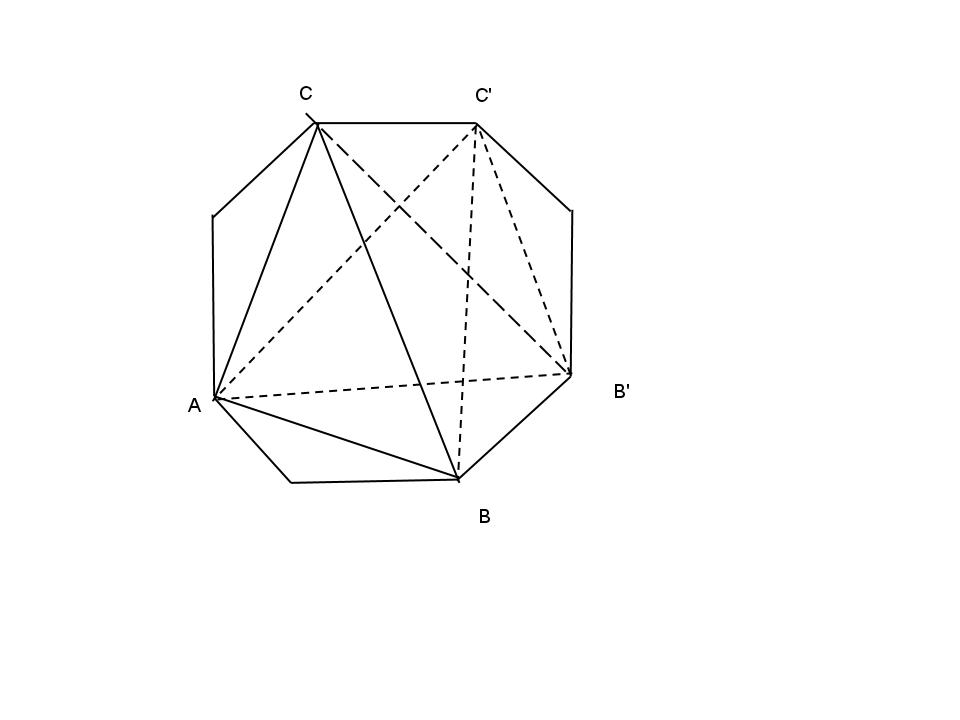
Now, after getting a maximum ABC for a fixed first point Pi, we will start with Pi + 1, Pi + 2 and Pi + 3. We get A'B'C' as a stable triangle i.e. s(pi, pi + 1, pi + 2) = A'B'C'. Hence our algorithm is O(n ^ 2). But it can be proved that, rather than, start from Pi + 1 as a second point and Pi + 2 as a third point, we can start with B and C as a second and third point and get the same result, i.e. s(Pi + 1, Pi + 2, Pi + 3) = s(Pi + 1, B, C), where s(Pi, Pi + 1, Pi + 2) = ABC.

Lets assume that we are wrong, and s(Pi + 1, Pi + 2, Pi + 3) = A'B'C' > s(pi, Pi + 1, Pi + 2).

Case 1:
B' < B and C' = C


We know that,
ABC >= AB'C (otherwise largest triangle for A would be AB'C)
=> ABC + BB'A >= AB'C + BB'A
=> AB'BC >= AB'C + BB'A
=> AB'C + BB'C >= AB'C + BB'A
=> BB'C >= BB'A
=> BB'C >= BB'A' (for base BB' area is non decreasing from BB'C to BB'A, so it
will be non decreasing from BB'A to BB'C)
=> BB'C + A'B'C >= BB'A' + A'B'C
=> A'B'BC >= BB'A' + A'B'C
=> A'BC + BB'A' >= BB'A' + A'B'C
=> A'BC >= A'B'C
=> A'BC >= A'B'C' ...... [1] (as C = C')

So, for case 1, s(Pi + 1, Pi + 2, Pi + 3) = s(Pi + 1, B, C).

Case 2:
Let's say, A'B'C' is the largest triangle for first point A'.
Where, B' < B and C' > C. See the following image.


For first point A, ABC is the largest trianlge,
So, ABC >= AB'C
=> ABC + BB'C >= ABC + BB'C
=> ABC + BB'C >= AB'BC
=> ABC + BB'C >= ABC + BB'A
=> BB'C >= BB'A
i.e. BB'A <= BB'C Hence, BB'A <= BB'C' (otherwise, BB'A > BB'C and BB'A <= BB'C, which is not possible for a convex polygon) So, BB'A' <= BB'C' ... [2] (as the triangle area non increasing by moving C' to A, it will be non increasing from A to A') Now as we are considering, for first point A', the largest area triangle is A'B'C'. So, A'B'C' > A'BC'
=> A'B'C' + BB'A' > A'BC' + BB'A
=> A'B'C' + BB'A' > A'B'BC'
=> A'B'C' + BB'A' > A'B'C' + BB'C'
=> BB'A' > BB'C', this contradicts to [2].

So it is not possible to have, A'B'C' > A'BC' i.e. for case 2, s(Pi + 1, Pi + 2, Pi + 3) = s(Pi + 1, B, C).

Case 3:
Let's say, A'B'C' is the largest triangle for fixed first point A', where,
B' < B and C' < C

As ABC is the largest triangle having first point A,
either ABC' >= AB'C' (by moving B' to B, area increases) .. (3A)
or AB'C >= AB'C' (by moving C' to C, area increases) .. (3B)

Case 3A
ABC' >= AB'C'
=> ABC' + BB'A >= AB'C' + BB'A
=> AB'BC' >= AB'C' + BB'A
=> AB'C' + BB'C' >= AB'C' + BB'A
=> BB'C' >= BB'A
=> BB'C' >= BB'A' (As by moving C' to A area non increasing, moving A to A' will area be non increasing)
=> BB'C + A'B'C' >= BB'A' + A'B'C'
=> BB'A'C' >= BB'A' + A'B'C'
=> BB'A' + A'BC' >= BB'A' + A'B'C'
=> A'BC >= A'B'C'

So it is not possible to have, A'B'C' > A'BC' i.e. for case 3A, s(Pi + 1, Pi + 2, Pi + 3) = s(Pi + 1, B, C).

Case 3B
AB'C >= AB'C'
=> AB'C + CC'B' >= AB'C' + CC'B'
=> AB'C'C >= AB'C' + CC'B'
=> AB'C' + CC'A >= AB'C' + CC'B'
=> CC'A >= CC'B'
=> CC'A' >= CC'B' (As moving A to B', area decreases, it's not possible moving A' to B' area increases)
=> CC'A' + A'B'C' >= CC'B' + A'B'C'
=> A'B'C'C >= CC'B' + A'B'C'
=> CC'B' + A'B'C >= CC'B' + A'B'C'
=> A'B'C >= A'B'C'

So it is not possible to have, A'B'C' > A'B'C i.e. for case 3B, s(Pi + 1, Pi + 2, Pi + 3) = s(Pi + 1, B, C).

Case 4:
C' < C and B' = B

Here,
ABC >= ABC'
=> ABC + CC'A >= ABC' + CC'A
=> ABC + CC'A >= ABC'C
=> ABC + CC'A >= ABC + CC'B
=> CC'A >= CC'B
=> CC'A' >= CC'B
=> CC'A' + A'BC' >= CC'B + A'BC'
=> A'BC'C >= CC'B + A'BC'
=> A'BC + CC'B >= CC'B + A'BC'
=> A'BC >= A'BC'
=> A'BC >= A'B'C' (as B' = B)

So it is not possible to have, A'B'C' > A'BC i.e. for case 3B, s(Pi + 1, Pi + 2, Pi + 3) = s(Pi + 1, B, C).

Case 5:
B' > B and C' < C


Now,
A'BC >= A'BC' (From case 4)
=> A'BC + CC'B >= A'BC' + CC'B
=> A'BC'C >= A'BC' + CC'B
=> A'BC' + CC'A' >= A'BC' + CC'B
=> CC'A' >= CC'B
=> CC'A' >= CC'B'
=> CC'A' + A'B'C' >= CC'B' + A'B'C'
=> CC'B'A' >= CC'B' + A'B'C'
=> CC'B' + A'B'C >= CC'B' + A'B'C'
=> A'B'C >= A'B'C'

So it is not possible to have, A'B'C' > A'B'C i.e. for case 5, s(Pi + 1, Pi + 2, Pi + 3) = s(Pi + 1, B, C).

So, from all of the 5 possible cases, we found that, s(Pi + 1, Pi + 2, Pi + 3) = s(Pi + 1, B, C). So our algorithm will still work, if we start our iteration for first point i = i + 1, without changing the position 2nd and 3rd point. We will move first point from 0 to n - 1, and 2nd and 3rd point will also not move more than n times. So our algorithm in worst case is O (3 * n) = O(n)

My simple implementation in C++.


#include<cstdio>
#include<cstring>
#include<cmath>
#include<cstdlib>
#include<vector>
#include<string>
#include<algorithm>
#include<set>
#include<map>
#include<cassert>
#include<sstream>
#include<queue>
#include<stack>
#include<iostream>
using namespace std;

struct Point {
int x;
int y;
Point(int _x, int _y) : x(_x), y(_y) {}
Point() : x(0), y(0) {}
bool operator <(const Point& p) const {
return x < p.x || (x == p.x && y < p.y);
}
};

bool left_turn(const Point& p1, const Point& p2, const Point& p3) {
return (p2.y - p1.y) * (p3.x - p1.x) - (p2.x - p1.x) * (p3.y - p1.y) > 0;
}

// Returns list of points of convex hull in counter clockwise
// The last point and first point will be equal
vector<Point> convex_hull(vector<Point> p) {
vector<Point> ret;
sort(p.begin(), p.end());
// build lower hull
for (int i = 0; i < p.size(); ++i) {
while (ret.size() >= 2 &&
left_turn(ret[ret.size() - 2], ret[ret.size() - 1], p[i])) {
ret.pop_back();
}
ret.push_back(p[i]);
}
int lower_hull_size = ret.size();
// build upper hull
for (int i = p.size() - 2; i >= 0; --i) {
while (ret.size() - lower_hull_size >= 1 &&
left_turn(ret[ret.size() - 2], ret[ret.size() - 1], p[i])) {
ret.pop_back();
}
ret.push_back(p[i]);
}
return ret;
}

double triangle_area (const Point& p1, const Point& p2, const Point& p3) {
return abs((double) p1.x * p2.y +
(double) p2.x * p3.y +
(double) p3.x * p1.y -
(double) p1.y * p2.x -
(double) p2.y * p3.x -
(double) p3.y * p1.x) / 2.0;
}

int main (void)
{
int n;
while (scanf("%d", &n) && n != -1) {
vector<Point> p;
for (int i = 0; i < n; ++i) {
int x, y;
scanf("%d%d", &x, &y);
p.push_back(Point(x, y));
}
p = convex_hull(p); p.pop_back();
int i = 0;
int j = i + 1;
int k = j + 1;
double res = 0.;
while (true) {
double area = triangle_area(p[i], p[j], p[k]);
while (true) {
while (true) {
int nk = (k + 1) % n;
double narea = triangle_area(p[i], p[j], p[nk]);
if (narea >= area) {
k = nk;
area = narea;
} else {
break;
}
}
int nj = (j + 1) % n;
double narea = triangle_area(p[i], p[nj], p[k]);
if (narea >= area) {
j = nj;
area = narea;
} else {
break;
}
}
if (area > res) res = area;
i++;
if (i == j) j = (j + 1) % n;
if (j == k) k = (k + 1) % n;
if (i == n) break;
}
printf("%.2lf\n", res);
}
return 0;
}


Thursday, August 18, 2011

Maximum Triangle Area (Part 2)

I hope you enjoyed the part 1. In part - 1. We came up to an algorithm of complexity O(n ^ 2 log n). We'll try to improve it now.

Our problem is now reduced to: Given a convex polygon having n points. Find three points from these n points which form the largest triangle area.

Let's consider our points are ordered in counter clockwise and named P0, P1, ... , Pn - 1.

Let's start with A = P0, B = P1, C = P2. Now we will be moving C counter clockwise order (i.e. P3, P4, ...), as long as the triangle area doesn't decrease. And we know(from part 1), the area will not increase anymore after this point. So let's stop moving C. Let's say, we stopped C at Pk. So we found the largest triangle, having A = P0, and B = P1. Now it's time to move B. Let's move B to the adjacent point clockwise, if the area doesn't decreases. Now for new AB we have to find the best position of C, so that area is maximized. We will find that, we don't need to iterate from the next point of B, rather we can proceed with C as where it is now and try to move it counter clockwise as long the area doesn't decrease. Will it work always? Let's consider that it will not work, i.e. There will be a case where for a given AB, we will find maximum triangle ABC, and after moving B to B', we will find maximum triangle AB'C', where C' comes before C (By C' comes before C, I mean if we count points of the polygon starting from A, C' will come before C), and AB'C' > ABC, as the following picture.


In the image above, we got ABC as the largest triangle for base AB. And after moving B to B', we got the largest triangle AB'C', where C' comes before C.
we know that, ABC >= ABC' ... [1] (As ABC is the largest triangle for base AB)
Now,
ABC' + ACC' = ABC'C = ABC + BCC'
=> ACC' >= BCC' [2] (as ABC >= ABC' from [1])

From (2), we can say, ACC' >= B'CC' (We already told for a given base, AB, if we move another point C, it will increase area of ABC up to a certain point and than start decreasing, i.e. it will never increase again after that point. Here for base CC', it started decrease from point A to B, so it will not increase from B to B'. As ACC' >= BCC', so ACC' >= B'CC').

ACC' >= B'CC'
=> ACC' + AB'C' >= B'CC' + AB'C' (adding AB'C' in both side)
=> AB'C'C >= B'CC' + AB'C'
=> AB'C + B'CC' >= B'CC' + AB'C'
=> AB'C >= AB'C'

So, for base AB' any point C' before C will not increase the area. So we can safely iterate from current position of C to find a larger area triangle. After finding the best position of C, move B again, if it increases the area. If moving B doesn't increases the area, stop moving B. Question is, is there any chance of getting larger triangle don't stop moving B in this case? Let's consider that there is a chance to get a larger area.


For example, in the above picture, for base AB we found ABC as the largest triangle, but after moving B to B' we found AB'C < ABC. Now for base AC, we already know that there area will not increase any more by moving B. And we also proved that area will not increase moving C in clockwise. So only way left is moving C counter clockwise. Let's say we found a solution AB'C', where C' comes after C. As this is a better solution, AB'C' > AB'C

Now, ABC > ABC' (If ABC' >= ABC, we would have already moved C to C' for base AB).
=> ABC + CC'A > ABC' + CC'A
=> ABCC' > ABC' + CC'A
=> ABC' + CC'B > ABC' + CC'A
=> CC'B > CC'A [3]

And, AB'C' > AB'C
=> AB'C' + CC'B' > AB'C + CC'B
=> AB'CC' > AB'C + CC'B
=> AB'C + CC'A > AB'C + CC'B
=> CC'A > CC'B [4]

[3] and [4] are contradictory. So if after moving B to B', the area decreases, it will not possible to get larger area for the same A. So we have to stop moving B, and this ABC is the largest triangle for a given A. As B can move up to n times and also C can move up to n times. So for a given A, our algorithm complexity is O(2n) ~ O(n). We have to do this for each possible position of A. So our algorithm becomes O(n ^ 2).

Hopefully you enjoyed it so far. We'll try to improve more in part 3.


Wednesday, August 17, 2011

Maximum Triangle Area (Part 1)

Today I'll discuss about another interesting problem. Though the analysis is big, hopefully you'll find it interesting.

Problem name: Maximum Triangle Area
Problem description:
Given n distinct points on a plane, your task is to find the triangle that have the maximum area, whose vertices are from the given points.

The most obvious solution is trying all possible triangle and find out the maximum area. The complexity of that algorithm is O(n^3). Which is huge as n can be as large as 50000.

So what can we do now? An interesting fact is, we can solve this problem by only considering the points of the convex hull for the given set of points. This will work because, if there is a triangle which has a vertex A which is not in the boundary of the convex hull, there will be always a point X in convex hull such that, by moving A to X we can increase the area of the triangle. Let's see an example -

We have a set of points {A, B, C, D, E, F, G, H, I}. The convex hull of these points consists of {D, E, F, G, H, I}. But let's claim that the largest triangle using these points is ABC. None of it's vertex is in convex hull. Let's say, BC is the base of this triangle and AP (perpendicular distance from A to BC) is the height of the triangle. So, the area of the triangle is 0.5 * BC * AP. Now draw a line parallel to the BC which goes through A. As A is inside the convex hull, you will find at least one vertex from the convex hull which is on the other side of the parallel line. Here in our example, we found D and BC are in the opposite side of the parallel line, so perpendicular distance from D to BC (DQ) is greater than AP. Hence, 0.5 * BC * AB < 0.5 * BC * DQ. So, triangle area DBC > triangle area ABC. See the following picture to make it clear -


Now, we got a triangle DBC which has larger area than ABC, but yet we have two vertices in it which are not in the convex hull. Now in the similar way considering DB as a base, and drawing a parallel line of DB which goes through C, we will find that area of DBF is greater than area of DBC. In the next step we can easily show again, that area of DBH is greater than the area of DBF. So we found that, maximum area triangle can be found using only convex hull vertices.


But if all of the given points is in the convex hull, our algorithm is still O(n ^ 3). Using the convex hull property we can improve it. Now our problem is finding the largest triangle using the vertices of a convex polygon. Let's say we have n vertices 0 to n - 1. We will try to find out three vertices A, B, C in clockwise direction from these vertices which will form the maximum triangle.

Now for a given AB, rather than iterating all of the points between B and A, to find the C, we can use ternary search to find C, as if we consider AB as a base, and iterate from the next point of B one by one, the height (of the triangle ABC) will increase in every step up to a certain vertex, and after that height will decrease in every step. This way, we can ternary search the point C for every possible AB, and the complexity will become (n ^ 2 log n), which is still not enough.

As, the analysis becoming large and large, we'll discuss the other improvements in the next part.

(Special thanks to Anna Fariha for helping me understanding some proofs of this analysis.)